Some thoughts on creativity, blocks and safety
Keywords: creativity, qualities, inner parts, psychotherapy, elements as symbols, Jungian typology - functions.
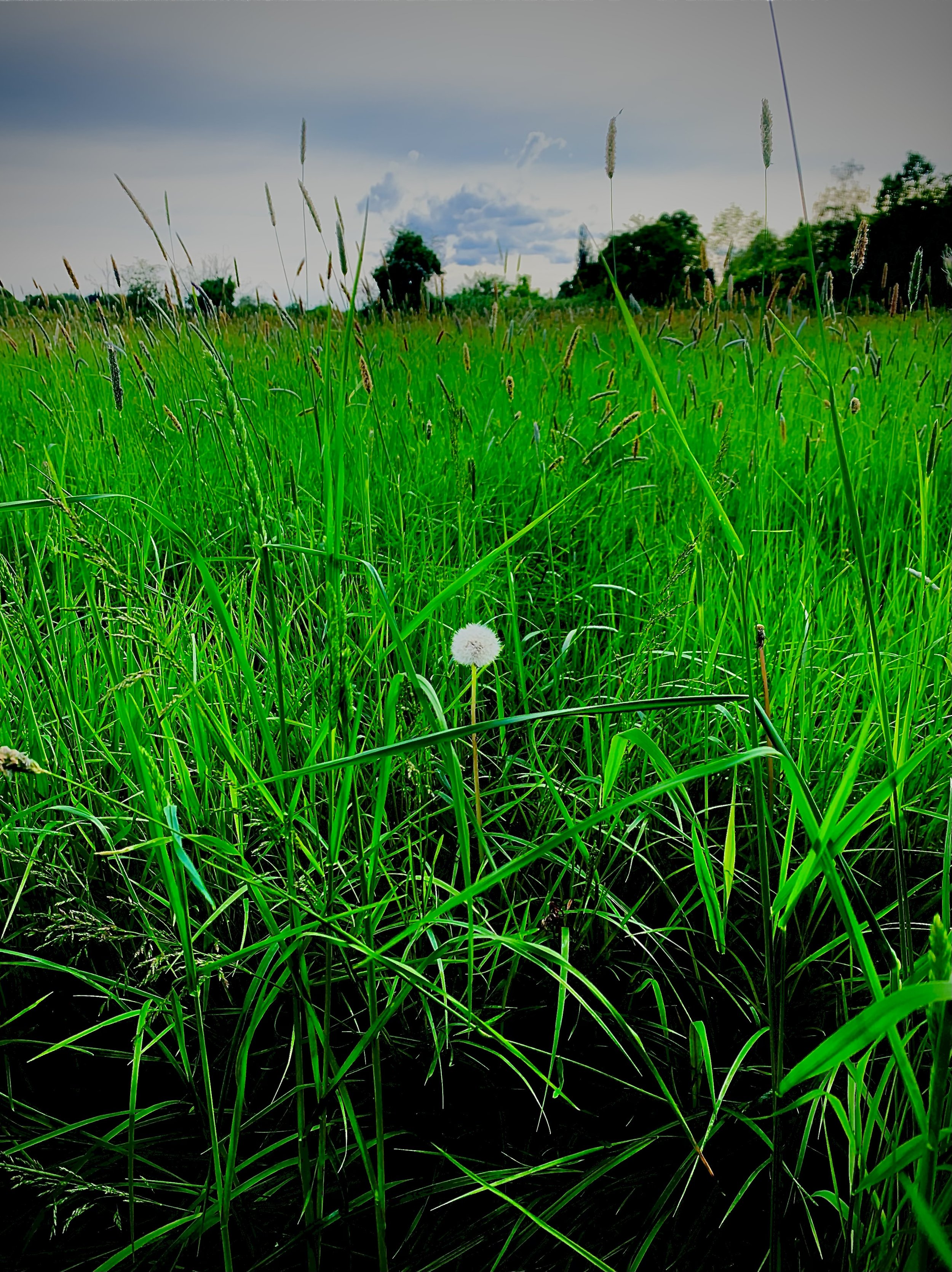
A solitary dandelion amongst the grass (copyright S. J. Bloxsidge.)
I take a breath - in through the nose - from the diaphragm - hold at the top of the breath - a quick extra breath at the top of the first breath - and exhale, sighing gently, for longer than the inhale. My shoulders drop - I feel a little less tense and try again.
The compelling agony of trying to write.
I’ve tried to start a few different blogs, and made attempts at writing various posts over the last few years.
I get stuck in cycles of having ideas, beginning and trying to post hastily completed drafts, second guessing what I’m doing, and then backtracking, deleting what was posted.
Needless to say, my inner critic has many times gotten the better of me.
I take a breath, and try again.
The fabled originator of Taoism, Lao Tzu said something that approximates to the cliché ‘all journeys begin with a single step’ (…it’s a good cliché.) Many small uncertain steps get us moving, until we feel confident enough to find our stride.
Supportive frameworks of understanding and encouragement :
Using Jungian personality typology as a guide to understand how my psyche takes in and processes information via the distribution of energy devoted to ‘functions’ - sensing, thinking, intuition, feeling; complemented by symbols from the classical elements of ancient Greece - earth, air, fire, water (as per CCPE’s ‘Elements model,’) representing associated character traits / qualities, I can bring together a general map of my process and patterns -
At the start of my present writing attempt, my air qualities / thinking function is metaphorically lifting me off the ground with a whirlwind of thoughts, driven by the fire / intuition seeking connections and patterns, resulting in a proliferating of ideas - a ‘hot air balloon’ feeling. This drive is hard to reign in, so that I can refine and prune the ideas down, so as to bring together some kind of realised version of what it is I’m attempting to say in this piece.
Here, I find I need to connect to the ability to structure and realise physical materialisation - to actually put words down coherently in a way that my reader might be able to make sense of. These skills could be symbolised by and realised through earth qualities / the sensation function.
This is tough work - making decisions means the death of possibility. Here I draw upon empathic water qualities / feeling function - attempting to offer myself compassion and kindness: holding a balnce with earth’s rigidity, finding the fluidity to accept things as they go down onto the page, flaws included. The feeling function also concerns values - is what I am saying aligned with my values, do I believe in what I’m writing - perhaps another cycle of refinement arises. And again, and again.
These words don’t need to be perfect.
They don’t have to necessarily be exactly as I hope them to be right now.
Things take time to percolate, process and feel ready - or perhaps I need to wrestle with them until I feel ready to accept them in their inevitable incompleteness.
I ask myself, ‘…what can I do right now that is easy, to generate the ‘grit’ from which the relative ‘pearl’ of creative realisation can be formed?’
Practicing and developing a writing or creative ‘practice,’ finding capacity to ‘take action’ and the ability to ‘let go’ are helpful concepts for me here - the goal is arriving at acceptance for what is. Maybe this acceptance can be achieved in a progressively sustainable manner through a balancing or harmonising of our functions, ‘parts’ and ‘elemental’ qualities - discovering where the tensions are that create blocks, navigating and resolving them. This, for me, is the work that sits beneath the creative process. It was so much easier when I was younger and my inner critic had far less conceptual fuel with which to police my creative inner child. The theoretical aspects of mind were hard won, but become a restrictive cage, when allowed to shift out of balance with, rather than form a supportive scaffold to the creative drive and process.
But how do we establish this practice, to enact any of the above?
‘Safety first’ seems to be a phrase that comes to me so often these days.
But why does safety matter?
In terms of context and conditioning, it’s likely many of us live in a demanding socio-cultural milieu. Certainly in developed and developing nations, it seems there is a focus on productivity, optimisation and success: hallmarks of meritocratic societies.
These societal, educational, occupational and familial messages that we must optimise put a lot of stress on us.
When we are stressed, we likely do not feel all that safe. Stress is a signal that our nervous systems have been activated, prompted to enter the ‘fight/flight/freeze/fawn/flop’ mode of activation, handled by the sympathetic branch of our nervous system - this releases stress hormones and redirects blood flow to our major muscles to prepare, simultaneously pausing non-urgent processes, such as digestion, and alters our breathing to help get more oxygen into our system faster. The key aim of this stress response is to tackle the stressor / potential danger and help us get ourselves back to safety, where the para-sympathetic side of our nervous system kicks in, helping us return to a ‘rest and digest’ state: our heart-rate drops, stress hormones cease to be release, autonomic processes resume and we can relax.
How we respond to stress and/or danger can be relative to the level of support, capacity and resources at our disposal.
The nervous system responds at an instinctual level, usually limiting our ability to reason through or make calculated choices about how we response, when the stress or danger are immediate or overwhelming.
If the stressor or danger feels somewhat familiar or manageable, it is possible to channel the instinctual energy in a skilled way.
At best, in a balanced and assertive way, we can connect to the energy driving the ‘fight’ response, and we can advocate for ourselves and/or defend ourselve effectively. If we do not have the resources or sense of support to do so, perhaps the next best thing is to get away from the stressor or danger, engaging the ‘flight’ response, retreating with a rationalised understanding that some battles are best avoided. These approaches allow us to deal with the stressful task in the heat of the moment, helping us to avoid or overcome the related danger, and return to a resting-safe state, through the activation of the parasympathetic branch of the nervous system.
But, when we can’t achieve resolution where the stressor or danger no longer prompt a stress response, we enter a state of chronic stress, which, over sustained periods can lead to burnout and other complications - even resulting in chronic illnesses.
Where creativity becomes a stressor.
We potentially go through all of the above in our working lives, and then come home and hopefully engage in restorative activities, such as hobbies, time with our friends and creative activities.
We might however carry the same sense of drive towards optimisation in to what should be the parasympathetic nervous system activating activities - where we had perhaps been hoping to allow our inner child out to play. Instead, with an optimisation type focus, our inner critic might pop up and start berating the inner child in us - telling us we’re ‘…not good enough…unworthy…no-one cares…why bother trying…’ and other such punitive messages.
This is pretty horrible to experience, but, our inner critic is trying, in its strange way to help us. Sadly, in the only way it understands how to - through means developed over a long time and possibly rooted in childhood, historically proven to make us safe by being ‘acceptable’ or driving us to be accepted by proving our worth to others, therefore not suffering the threat of isolation. Interestingly, it seems from opportunities to engage with peoples’ inner critics, overall, the critic mostly doesn’t want to be this way. Our inner critic would rather be doing enjoyable things, or being at least less harsh and more supportive, but they don’t feel they can trust us as a whole to do what the critic feels is best for us, in terms of maintaining safety - so, the inner critic cracks the whip and inadvertently punishes the inner child, which it is ultimately trying to keep safe, by shutting it away from the world and denying it the connection it needs to flourish.
How do we then reach a point of safety, as a foundation to build from?
There are many potential ways, but the important thing is that you find what works best for you, or that you feel truly connected to. Some loose start points are:
Somatic-neurologically informed ideas - we can use breath-work to calm our nervous system, as well as bilateral stimulation, proprioceptive feedback movements, and other associative safety objects/images/smells/visualisations, to help us get back into a parasympathetic state of rest and digest safety. From here, we will have more access to our prefrontal cortex driven reasoning, to be able to process our experiences.
Internal Family Systems informed (IFSi) ‘parts’ work would invite us to try and discover and build a connection with ‘Self,’ the inner part of us that we kow we’re in contact with when we feel calm, confident, connected, creative, compassionate, competent and courageous. Getting in touch with Self can then provide a safe central aspect of us to return to - an anchor point to which we can ‘un-blend’ from the critic. This ‘unbending’ helps us step back from being in the critic mode, and can help us to open a dialogue with it, over time building a more harmonious relationship with the inner critic (a ‘manager part,’) helping it to find the trust to step back, so that we can then access and work with the wounded inner-child part (exile) that the critic working so hard to protect, but is inadvertently keeping stuck.
Jungian functions and elemental qualities - as a further-complementary layer to the above examples, we can use these to map our strengths and which qualities might complement. This can be combined with Jung’s metaphorical use of the alchemical processes of transformation - helping us more clearly identify where the challenges within our material may lie. It also gives some guidance as to how we can meet these challenges and assess their nature. From this understanding we can explore how we might transform the challenges into opportunities for development and psycho-spiritual / holistic growth.
From the start-point of safety, then maybe we will have the ability to engage more creatively, flexibly and freely with the tasks in-front of us, and begin to experience how the tasks and challenges are the raw materials from which we can derive enrichment.
This is not a linear or one-time process, but an ongoing eccentric spiral-form set of practices, that will be adapted and evolving relative to your particular nature, experiences and contexts.
The work is complex, but can be deeply rewarding.
Fellow travellers.
I share the above as a person who very much has to engage in their own practice.
I am also psychotherapist, so I hold space for others to engage with and develop their practices concerned with figuring out what life is all about for them.
When we go to psychotherapy, we look for help and support from the therapist. We don’t often notice (initially) them as having walked, or simultaneously walking the same paths as we have and currently are. I certainly projected a similar version of this onto my therapists - seeing them as people who had gotten it all worked out. I am grateful and feel relieved that it emerged, in very affirming and helpful ways, over time that they hadn’t got it all worked out; they were vulnerable, messy complex people too. That made the therapeutic relationship feel closer and more real.
I suppose I’m writing this to offer a point on relatability, and the importance of the intersubjectivity of shared experiences: that are similar enough to give us a framework to understand each other by. In this way, I hope that I can meet you as an equal, both humans thrown into the world we inhabit and are part of. Fellow travellers on the road to as yet unknown destinations. As the person sitting in the therapist’s chair, it may be I have had the opportunity to aquire a few more theoretical maps, and had the chance to engage in experiential learning of traversing different paths - of my own and in as witness to those of others.
Building on the metaphors of travel, I’d say that therapy proceeds in an exploratory, experimental, often adventurous and creative manner.
With this in mind, the prospect of starting therapy can be a little scary, but my first and core objective is to do my best to help you feel safe within the therapeutic alliance. From this safe base, we have the foundation from which to creatively experiment with ways of working that will hopefully help you be able to understand and process your experiences, and find ways to engage with life in further ways that allow you to feel more authentic and experience increasing degrees of subtle fulfilment.
My hope is to offer a space where you can discover a greater sense of connection with yourself and the world you are part of. Where you might feel more actively involved in the authorship of your own existence. It is my ongoing experience that there is joy in the effort and agony of the process; they are worthwhile.
If you feel you might be interested in working with me -
Please get in touch via my contact page, to book a free-of-charge 20min consultation via Zoom.
I look forward to hearing from you.
Sam
All words and images copyright S. J. Bloxsidge
No generative A.I. was used to write this - all grammatical and spelling errors are my own. Apologies for the ones I’ve missed.